The short answer: the AI adoption metrics that matter sort into three questions. Which ones you lead with depends on where you are and who is reading.
The rest of this guide defines each one, groups them by the question it answers, and shows how to turn them into goals.
Artificial intelligence is on every executive's mind, touted as the next revolution in business. But amid all the hype, how do organizations ensure they're reaping real value from AI?
The tools driving that excitement span everything from productivity copilots to creative generators like Seedance 2.5 for AI video.
The key is measurement.
Just as you wouldn't invest in a new initiative without tracking its ROI, AI adoption needs to be quantified. Measuring which department is using AI, how often, what AI agents, and with what impact is crucial to bridge the gap between lofty promises and tangible outcomes. It's the difference between talking about AI and leveraging AI.
A recent global survey highlights why this is so important: AI adoption in companies surged to 72% in 2024 (up from 55% in 2023).
High adoption rates alone don't guarantee value. Simply deploying AI doesn't mean it's delivering results. Many firms enthusiastically enable AI features across the enterprise yet later discover that only a fraction of employees use them regularly. That's why measurement comes first. It separates true transformation from tech fads.
Access is not the same as habit. A raw access number tells you little on its own, which is why the metrics below focus on real, repeated use rather than logins.
Measurement is also the foundation of good AI governance: you cannot govern what you cannot see. It quantifies the baseline (for example, how many employees used an AI tool this month) and illuminates the breadth of usage across teams, roles, and locations.
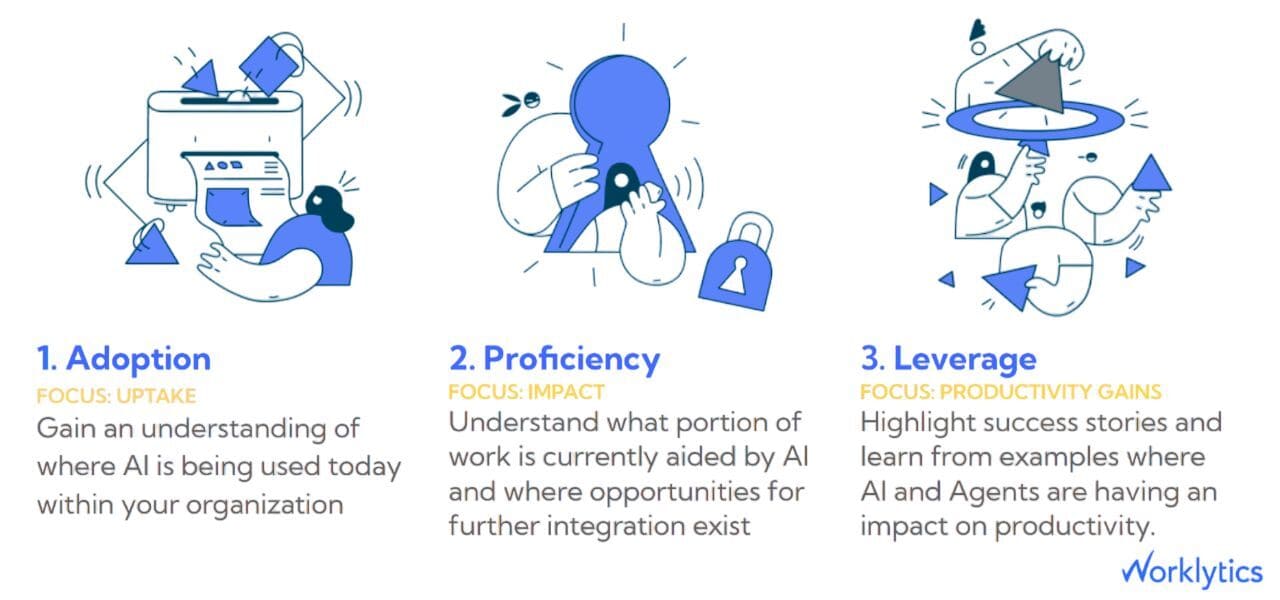
Before you pick metrics, know which stage you are in, because it tells you which question to push on. Most organizations sit in one of four stages. Experimenting: a small slice of people use AI, sporadically, so your job is access and awareness. Early adoption: use is spreading, so your job is turning triers into habitual users. Integrated: AI is part of daily workflows, so your job is depth and impact. Optimized: use is widespread with measurable business results, so your job is to protect and compound it. Naming your stage keeps the goal honest: a company where only a third of people have picked up AI should not be measuring ROI yet, it should be measuring habit. As a rule of thumb, experimenting and early stages live in Question 1, integrated in Question 2, and optimized in Question 3.
Not every number is a KPI. A KPI is one of the few measures you set a target on and report up. The rest are supporting signals that explain why a KPI moved, or dimensions you slice a KPI by.
| The question | Core KPIs | Supporting signals and slices |
|---|---|---|
| Is AI being used? | Active AI users % | by department, by manager, by tenure; light vs. heavy usage |
| Is it being used well? | % of work with AI, usage depth, AAFI, time-to-proficiency | adoption breadth, skill growth, the A to F team grade, tool mix |
| Is it worth it? | ROI by business unit, cost per active user, license utilization | productivity impact |
The first question is the simplest: are people actually using AI? The headline KPI is Active AI users %, the share of employees who used an AI tool in a given period, counting real use rather than who holds a license. On its own it is blunt, so read it three ways and watch the split between light and heavy users. (The figures in the examples below are illustrative.)
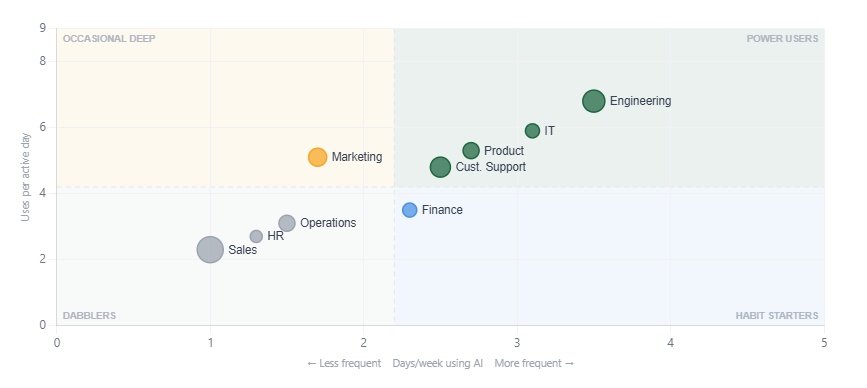
This metric segments users by the intensity of their AI use. What percentage of employees are heavy users (daily, or for a high share of their work) versus light users (occasional)? If a large chunk stay light users, it signals untapped potential, perhaps from lack of training or unclear value.
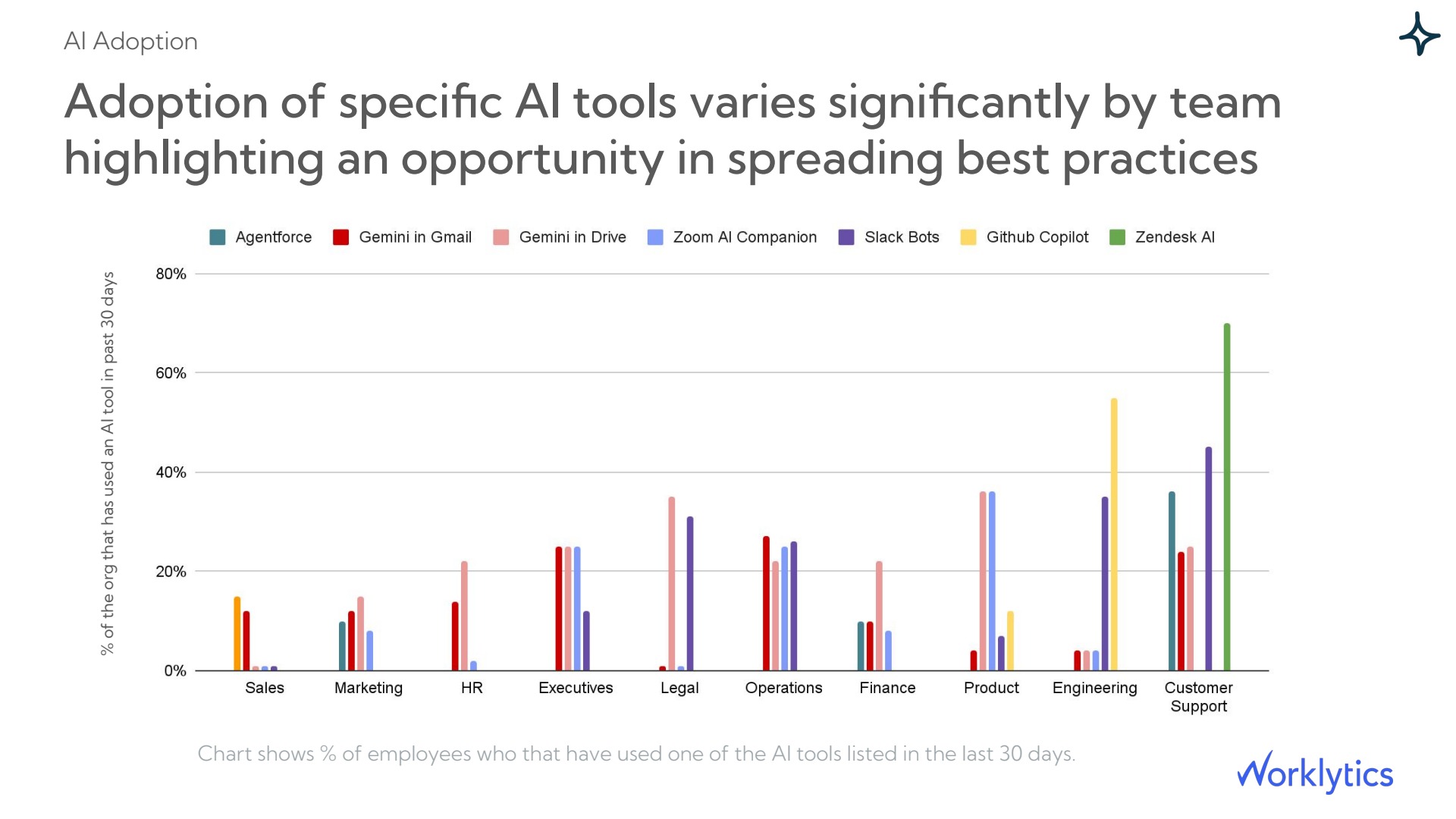
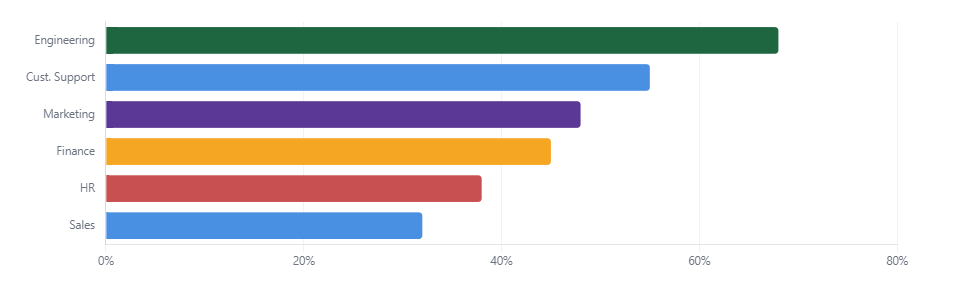
AI usage rarely spreads evenly. Measuring adoption by department reveals where AI is taking hold and where it is lagging. You might see Engineering and Support with far higher active use than Finance or Legal. Low adoption in a function can mean the tools are not suited to the work, or that leadership is not encouraging experimentation.
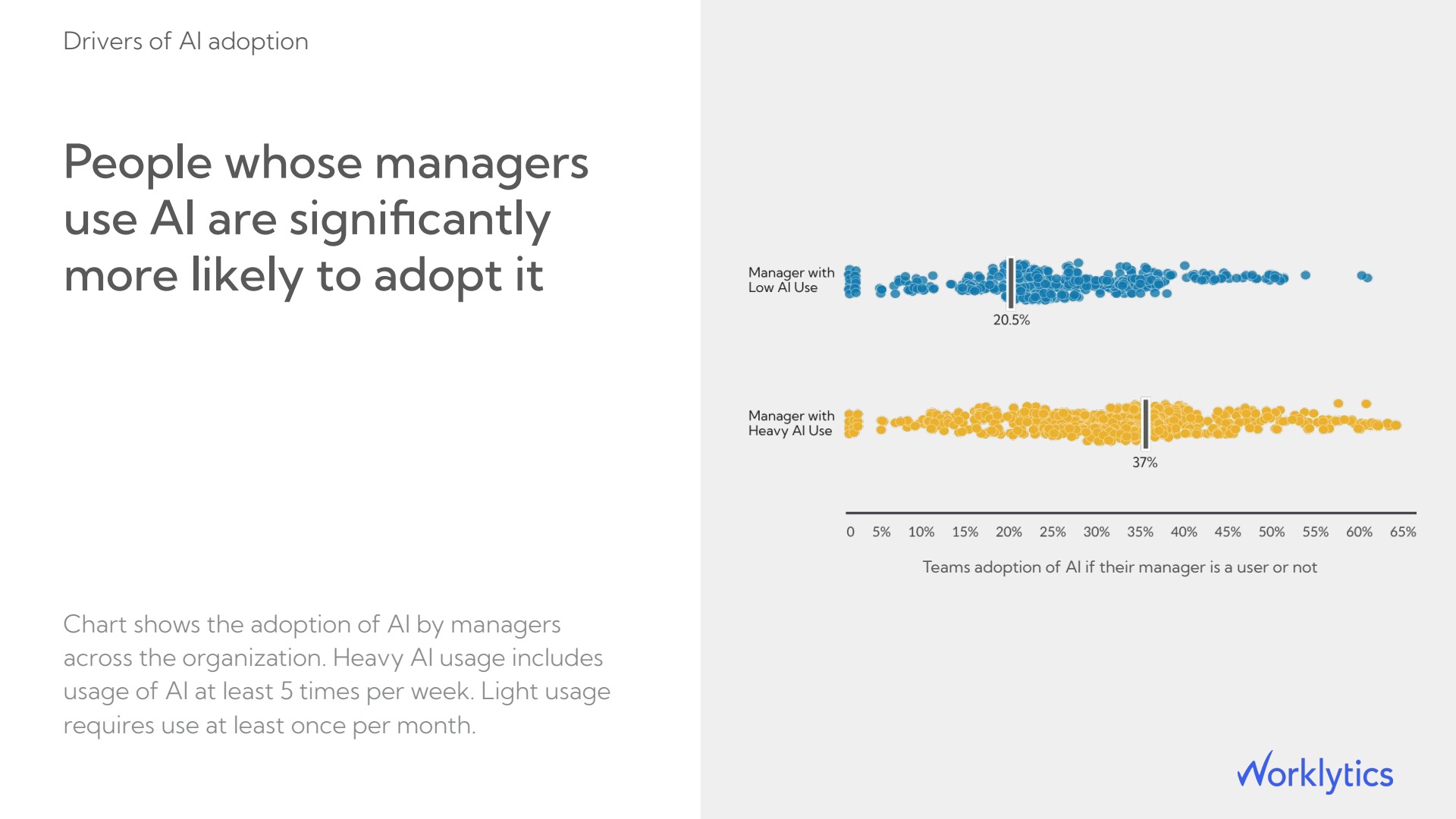
A subset worth highlighting: adoption among managers. Managers set the tone, so their usage is a read on cultural buy-in. If frontline reps adopt an AI assistant far faster than their managers do, that gap is a red flag, since weak leadership engagement can stall broader adoption. Where managers lead by example, their department overall usually follows.
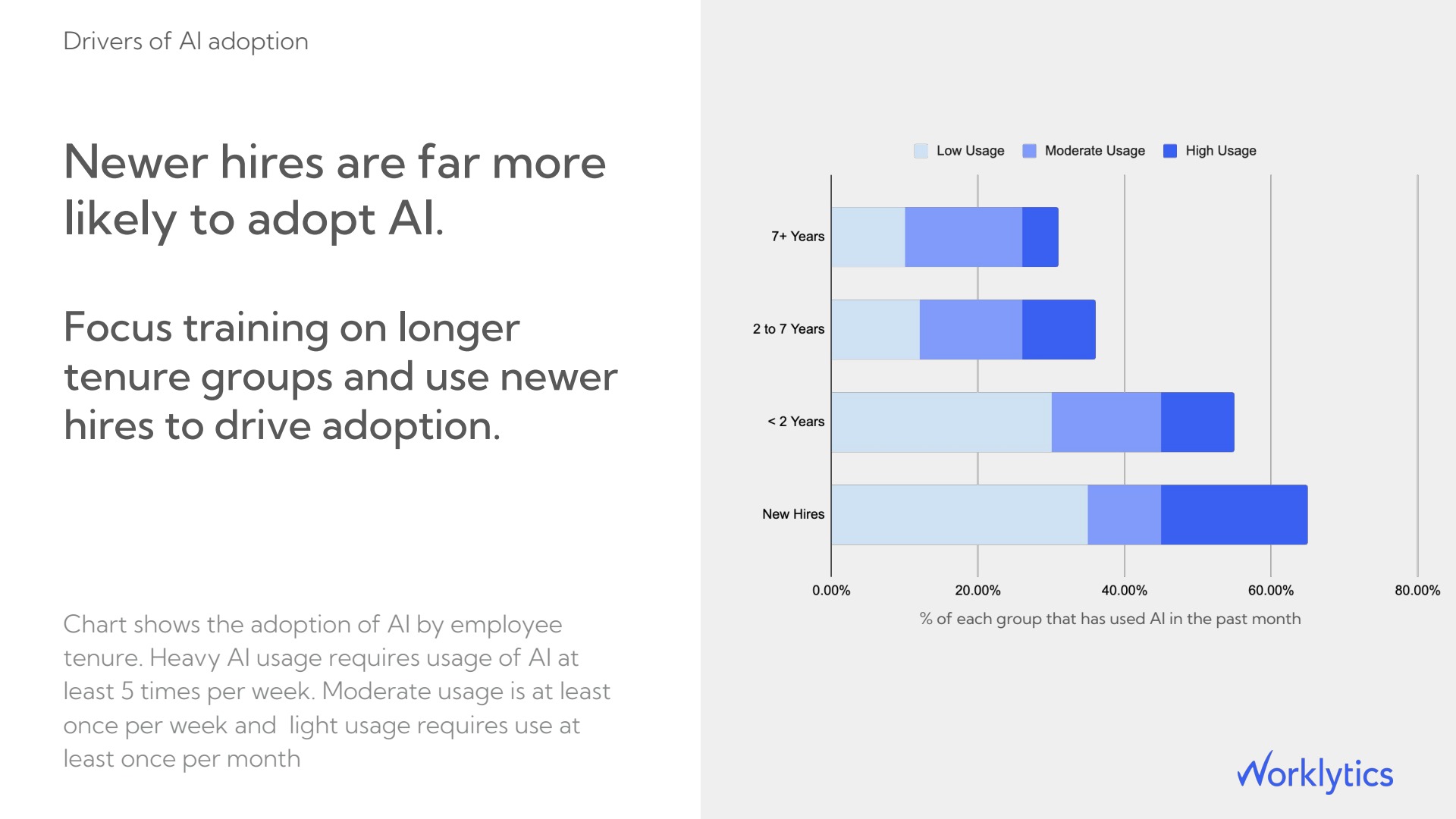
Do newer employees use AI more than veterans? New hires are often more recently trained, so you may see them pick AI up faster. A wide gap between recent hires and long-tenured staff points to a change-management need: upskill and reassure long-tenured staff. If tenured experts are the heavy users, turn them into AI mentors.
Stage note: if you are still experimenting or in early adoption, this question is the whole game. Measure habit first; ROI and cost come later.
Usage counts tell you how much. This question tells you how well. The headline KPI is the share of real work AI touches, supported by depth, skill, and how well managers pull their teams along.
This goes beyond user counts to the penetration of AI into real work. What portion of day-to-day tasks are AI-assisted, such as code commits with Copilot suggestions or support chats handled by an AI assistant? Tracking this focuses on depth of usage. Set a target (for example, a specific share of support resolutions involving AI assistance by a set quarter) and watch progress.

These three signals show how well AI is woven in, and they roll up into a single grade. Adoption breadth is how many distinct use cases a team touches (writing, analysis, coding, research); a team using AI for one thing is fragile, one using it for five has it woven in. Usage depth is simple one-step prompts versus complex, multi-step work, and depth, not prompt volume, is what tracks with real productivity. Skill growth is whether the team improves over time. Together they roll up into a simple A-to-F grade per team.
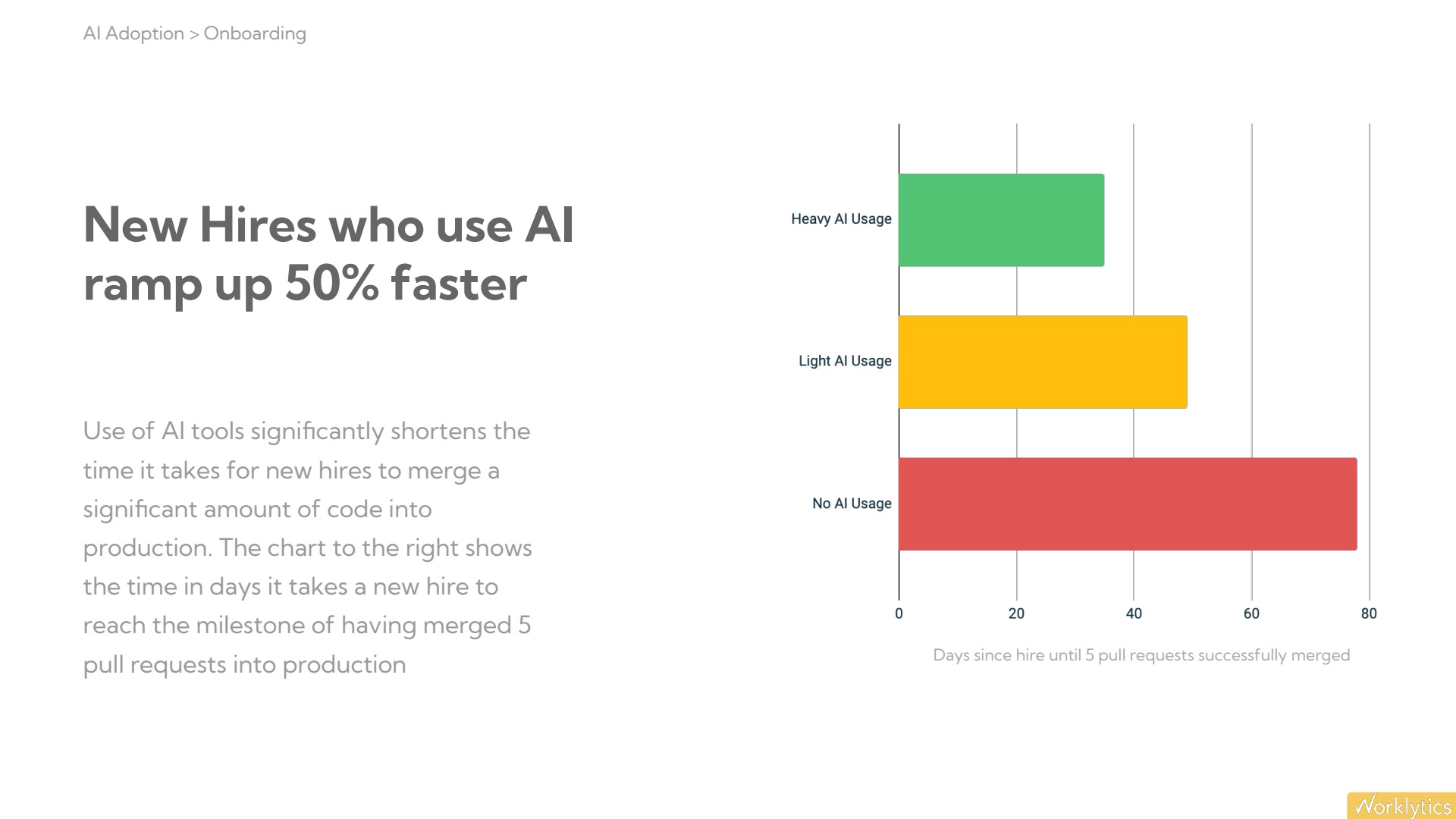
Time-to-proficiency is how long a new user takes to go from first prompt to steady, regular use. It is the cleanest read on whether onboarding and training are landing. If it creeps up, your enablement is not working.
Manager usage tells you whether managers use AI. It does not tell you whether they are pulling their team along, and that is usually the biggest lever. The Adoption Facilitation Index (AAFI) is a composite score you can build for exactly that. It combines weighted usage (advanced actions counted more heavily than a quick autocomplete), manager engagement (1:1s, AI on meeting agendas, how fast they unblock the team), and momentum (the rate of change in usage). Scored against a baseline, it surfaces the manager influence gap: two teams with identical tools can have very different adoption, and the difference is almost always coaching. It turns adoption from an IT problem into a management one.
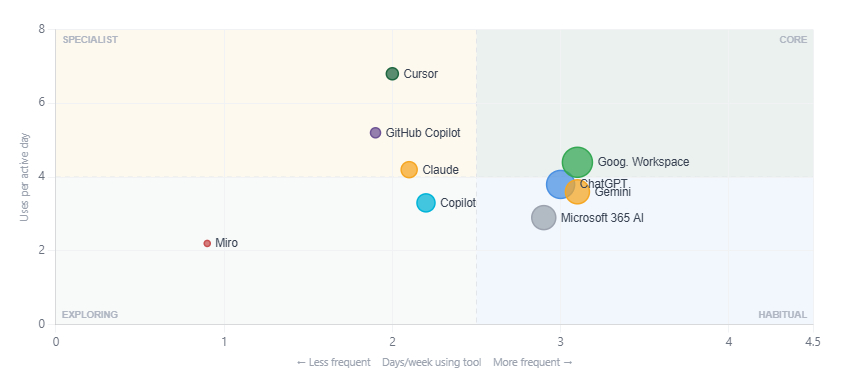
Most organizations run several AI tools. This metric shows which are used most, and by whom, so you can see whether usage concentrates in one platform or spreads across many. A high share signals value; a very low share is a candidate for reevaluation or better promotion. It also flags where a critical function depends on a single platform.
Once people use AI well, leadership wants the money question answered. This is where adoption meets the budget, and where the C-suite spends its attention.
ROI by business unit sets productivity and revenue impact against AI cost per unit, so budget follows the teams getting returns. It decides where the next dollar of AI spend goes.
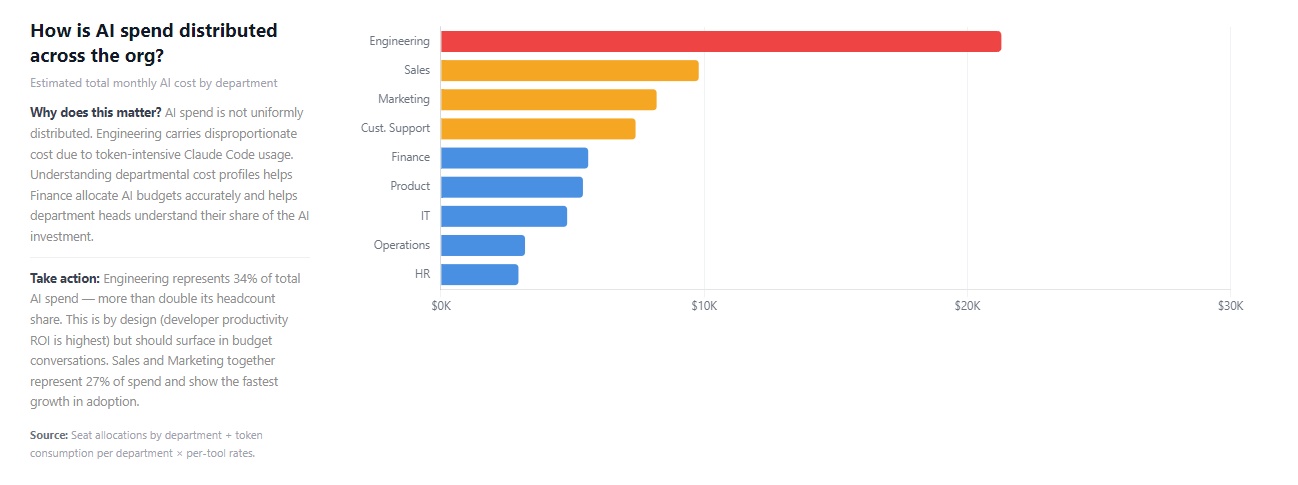
Cost per active user is total AI spend divided by the people actually using it, not the licenses bought. It is the fastest way to catch paid-for-but-idle seats, and it should trend down as adoption scales.
License utilization is the share of paid seats in regular use. It is often the fastest saving, because reclaiming idle seats is money back immediately.

Productivity impact ties usage to outcomes such as cycle time, output, or quality, so you can show AI is moving the work, not just the login count. Pair it with ROI so the story is both effort and return.
The same KPIs ladder up, but different readers lead with different questions. A manager dashboard lives mostly in Questions 1 and 2: who is using AI, how well, and the AAFI and red flags that show where to coach. A board dashboard leads with Question 3: ROI and cost, with adoption as supporting context. Build one data set, then show each audience the layer it needs.
Collecting metrics is only half the battle. The real goal is to act on them.
Segment and pinpoint. Break metrics down by department, role, and location to find where uptake is strong and where it is lagging. If R&D leans on AI while Operations barely touches it, that is a prompt to investigate why.
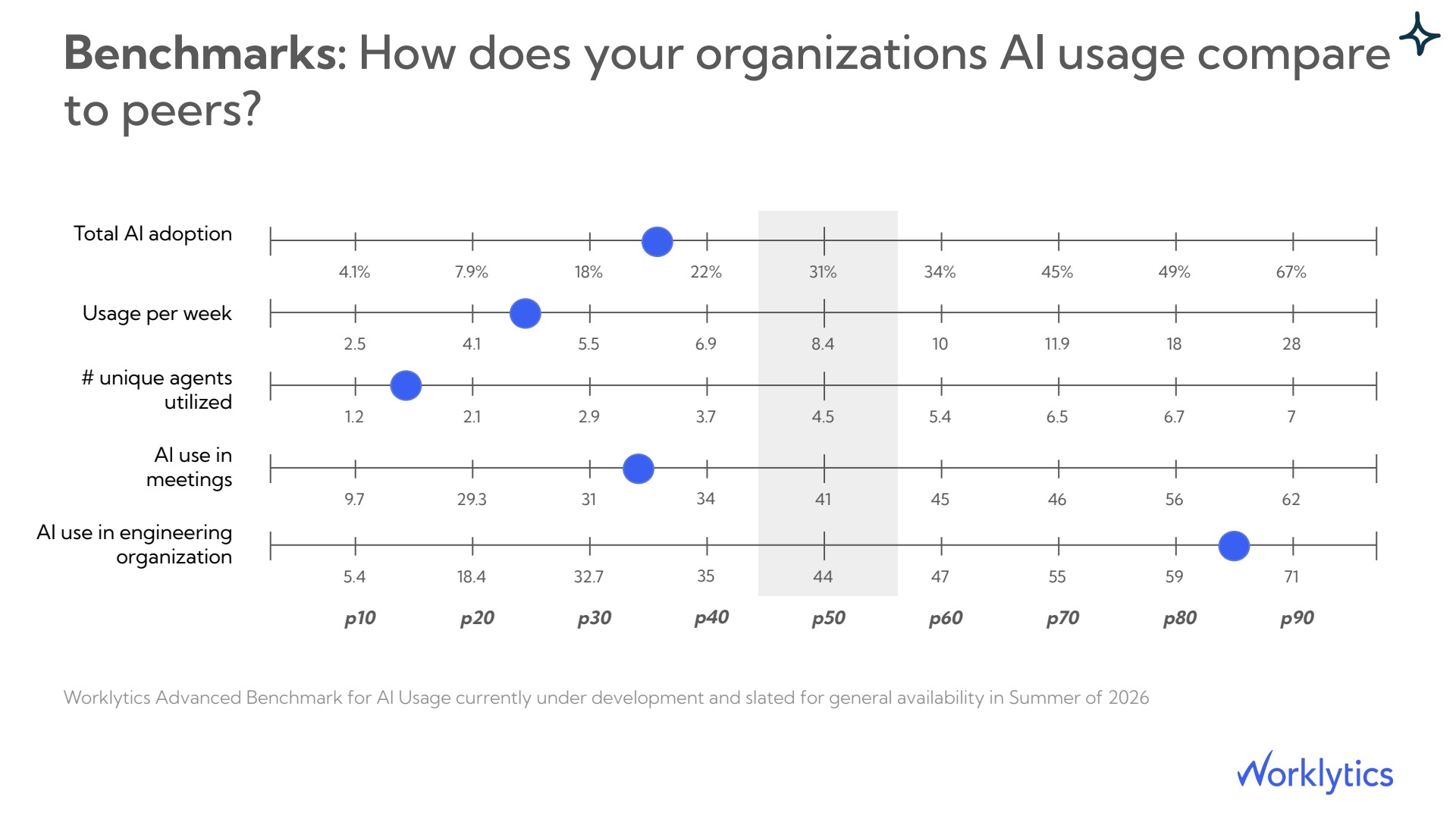
Benchmark and compare. A trendline of adoption climbing or plateauing tells you whether last quarter's training moved the needle, and lets you compare against industry peers.
Implement feedback loops. Collect a baseline, take an action (a targeted training, or an 'AI champion' course for managers), then watch the metrics. If interactions per user rise after training, the intervention worked. If they stay flat, rethink the approach.

Give managers a short list of signals that mean act now, not note it: a team averaging only a handful of prompts per person a month; more than a quarter of the team with zero AI use in the last 30 days; usage trending down two months running; or a big gap between people in the same role. Each is a coaching conversation, not a dashboard footnote.
Metrics do not move behavior; goals do. A few starting templates by function, set against your own baseline. Engineering: grow active AI-coding users toward three-quarters of the team, cut pull-request cycle time, hold code quality steady. Finance: grow active users, shorten the monthly reporting cycle, automate routine analysis. Sales and marketing: put AI writing assistants in most hands, lift content output, improve lead-qualification accuracy. IT operations: extend AI monitoring across critical systems, cut mean time to resolution, automate routine tickets.
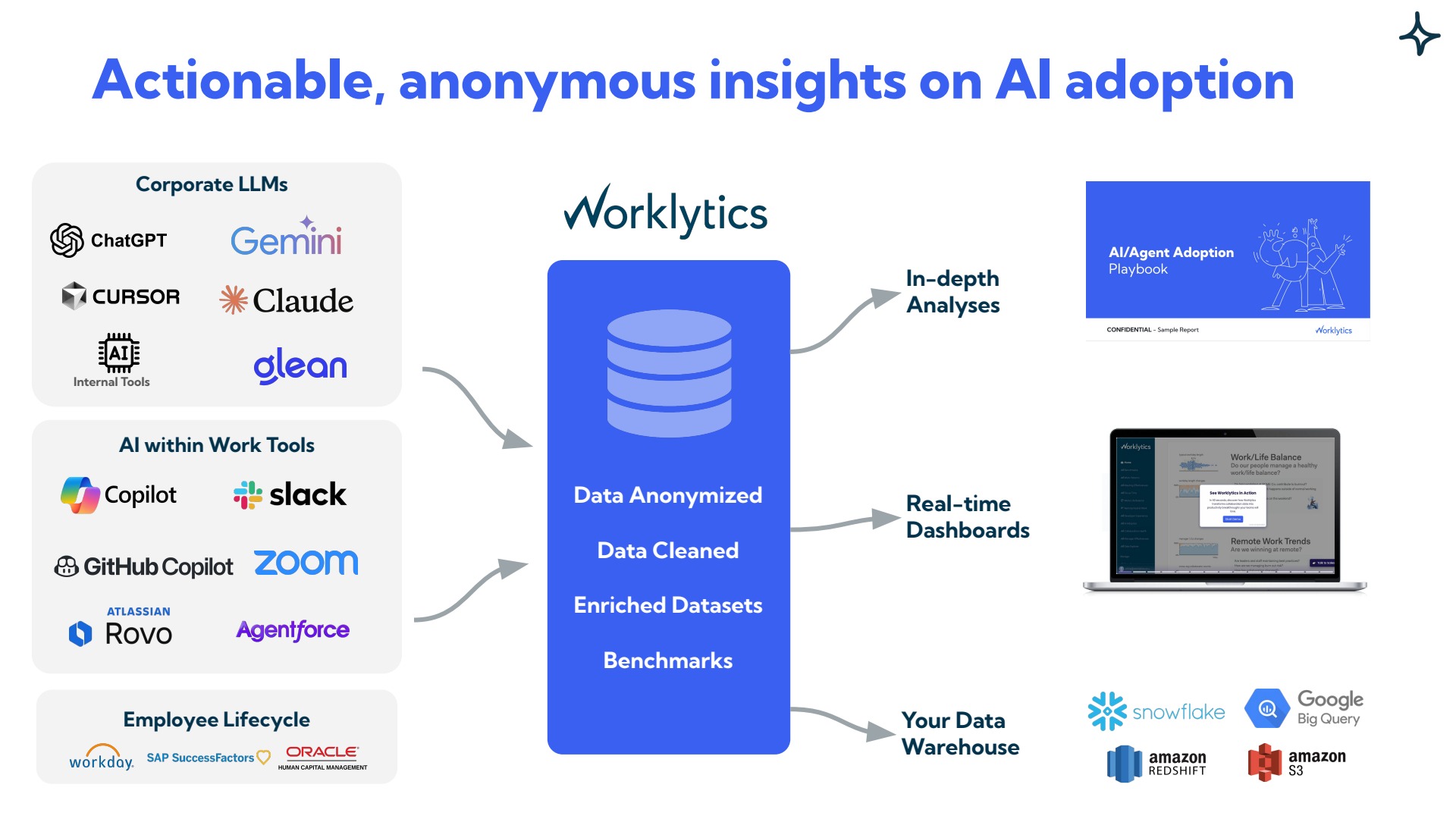
Measuring and visualizing AI usage across an entire organization can sound daunting, since modern enterprises use a plethora of tools. This is where Worklytics comes in: a people-analytics platform that aggregates work-activity data (while protecting privacy) into insights, with a dedicated AI Adoption analytics module that tracks usage across the apps your teams rely on daily.
Worklytics plugs into the AI-powered apps and collaboration hubs your teams already use, including:
By tapping into the usage logs or APIs of these tools (with appropriate permissions and security), Worklytics consolidates data on who is using AI, how often, and in what ways. The dashboard surfaces adoption and usage by team and role, trend lines over time, and benchmarks versus industry peers. Its Organizational Network Analysis (ONA) even maps how AI agents move through collaboration patterns. In short, it brings every key metric under one roof instead of cobbling together separate admin reports.
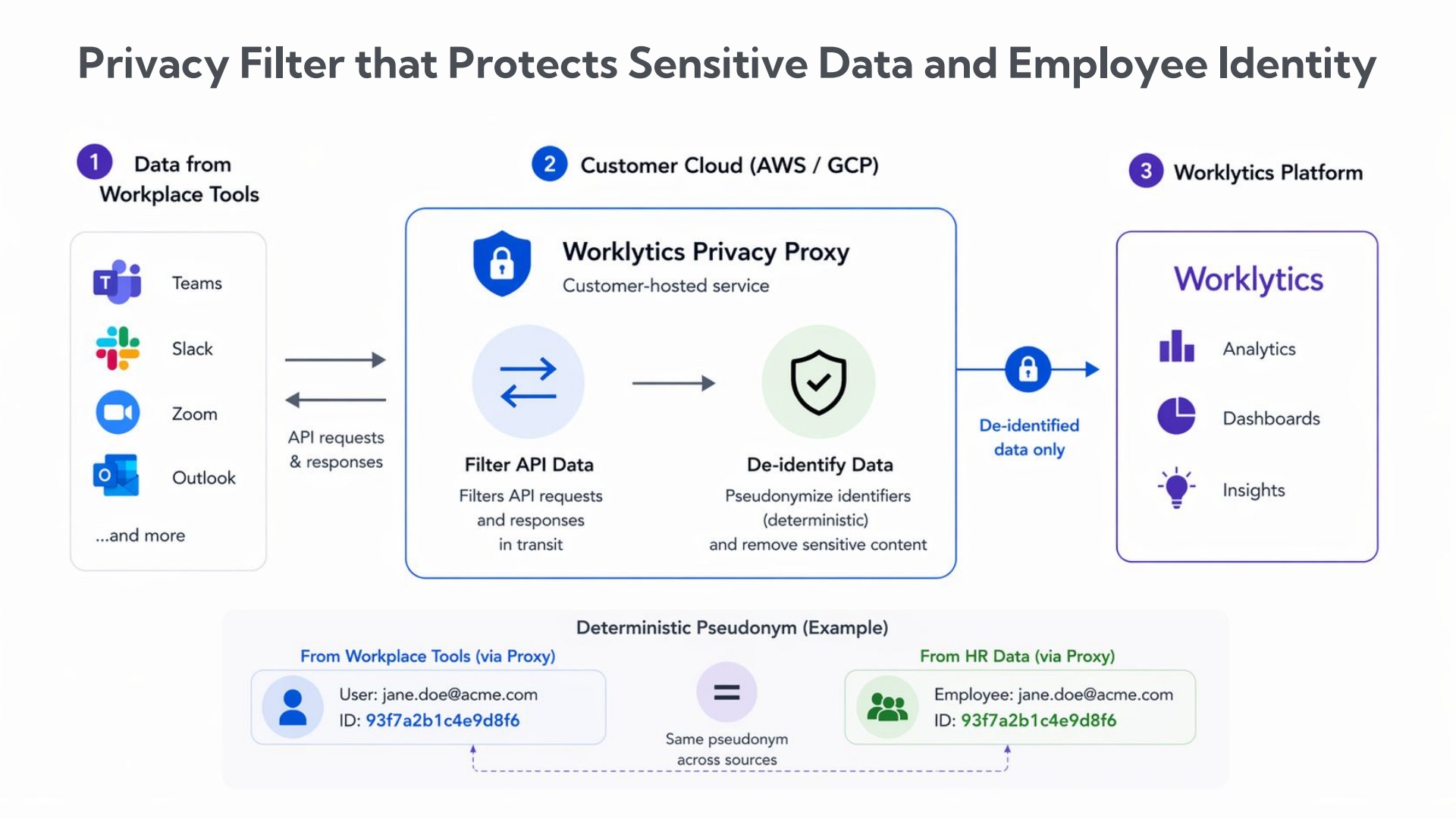
Tracking how employees use AI raises a fair question: how do you protect privacy? Worklytics uses a privacy-by-design approach built on anonymized and aggregated data, so you get insight without exposing individuals. The platform aligns with GDPR, CCPA, and other regulations that demand strict handling of personal data. For a deeper look, see our guide on measuring employee AI use without invading privacy.
Seeing your AI usage in isolation is useful; seeing it against peers is powerful. Worklytics lets you compare your adoption to industry benchmarks or similar-size companies, anonymously, and set realistic goals. If top performers hit a high adoption rate, that is your north star; if most peers struggle to pass halfway, a modest gain already puts you in a leadership position.
In the new era of AI, the organizations that thrive will be those that close the loop between enthusiasm and execution. With the right tooling, measuring AI usage is privacy-protected, automated, and insightful. Instead of flying blind, you gain a dashboard for your AI journey, complete with benchmarks and feedback loops.